Tone Poems
It’s curious how many photographers are also musicians. I’m another one.
But whether one plays or not, maybe we can all sense “musical” harmonies in the landscape—and make music with our images.
I call it “a symphony of shadows.” Or, if you like, think of a soloist with accompaniment…? Or melody and counterpoint? Treble and bass? Or rhythms and tonalities that equal chord clusters. OK, then maybe it’s more like a tone poem? Debussy with a Nikon. A single, rectangular song—your song.
Ansel Adams, who trained to be a concert pianist, famously said: “The negative is the equivalent of the composer’s score, and the print is the performance.”
So, what’s the notation for that score? It’s exposure. And as I outlined in “Ten Tips,” there’s an interlocking “holy trinity” of exposure settings: aperture; shutter speed; and ISO. Change one and the others change, too. Understand them all and you start to make music with light.
First, let’s talk stops. Aperture is like light moving down a tunnel, or like water through a hose, and the size of that circle gets bigger or smaller in units of “f-stops.” Each successive aperture number that’s marked on your lens, like f5.6, f8, and f11, gives half the light in one direction, and double the light in the other. The bigger the f-number, the smaller the opening—and the less the light. (Yep, smaller numbers equal more light; it’s kinda confusing!) BUT the higher the number, the greater the depth of field (DOF)—or range of apparent focus from front to back. And that’s where the term “stopping down” comes from.
Next comes shutter speed, which is like placing a moving curtain or valve gate across that path. Faster speeds—like, say, 1/500th of a second and up—can freeze motion; slower speeds will eventually start to blur things—either via their own movement, a breeze, or your hand shaking the camera. Again, increasing the shutter speed (from, for example, 1/30th to 1/60th of a second), is the same as closing the aperture one stop. Half the light. Going from 1/30th to 1/15th of a second doubles the light.
And, finally, there’s ISO, the baseline sensitivity of a film stock or sensor. And, I’ll be durned, it’s the same here, too: double (or half) the numerical value equals a one-stop difference. It goes from, say, 100 to 200 to 400 to 800, and so on. ISO is like the volume knob on your guitar amp. A higher ISO is more sensitive to light, i.e. louder, but that may come with grain or noise, more contrast, lower resolution, and less tonality (sorta like that guitar feedback!)—so it’s often best to keep it as low as you can. Note: a change in ISO affects both aperture and shutter speed.
So, how is this light measured? Reflective meters read the light that’s bouncing off your subject and back at you. Incident meters show the light that’s shining onto your subject. Most modern-day meters for landscape work are reflective. Built-in camera meters, once a bit sketchy, have gotten quite good.
All meters, whether they read tiny, individual spots or sample the larger frame in one of several ways, simply strive to produce one thing: a so-called “middle” or “18 percent” grey. This is the center point of AA’s famed “Zone system” for black & white negative film—or Zone 5 on a scale from 0 (pure black) to 10 (pure white). Each zone equals one stop.
Color wears different clothes, but has the same bones beneath. But color positive or transparency film, which is what I’ve mostly used, has a much more limited latitude or dynamic range than negative film, only 5 stops or so. I figure from, say, Zone 2 to Zone 7, with again, Zone 5 being the middle point. And this is being optimistic: I’d hesitate to place anything important below Zone 3 or so, or above Zone 6. On the other hand, the best modern digital sensors render 10 stops of color, or even more. Nice!
And speaking of digital, for maximum headroom and shadow detail, it’s best to shoot in RAW format, rather than jpeg. And in the largest color space you can; I use ProPhoto.
You may well be saying: “If meters have ‘gotten quite good,’ why would I bother with this stuff at all?” Three reasons: 1) You want to pick the exact aperture and/or shutter speed for your needs; 2) You’d like to capture as much tonal information as possible; and/or 3) You’re hearing a different scale…or melody…or register than the one the camera sees. Whether or not you make any changes, it’s nice to know you can.
Sound useful? See you next time.
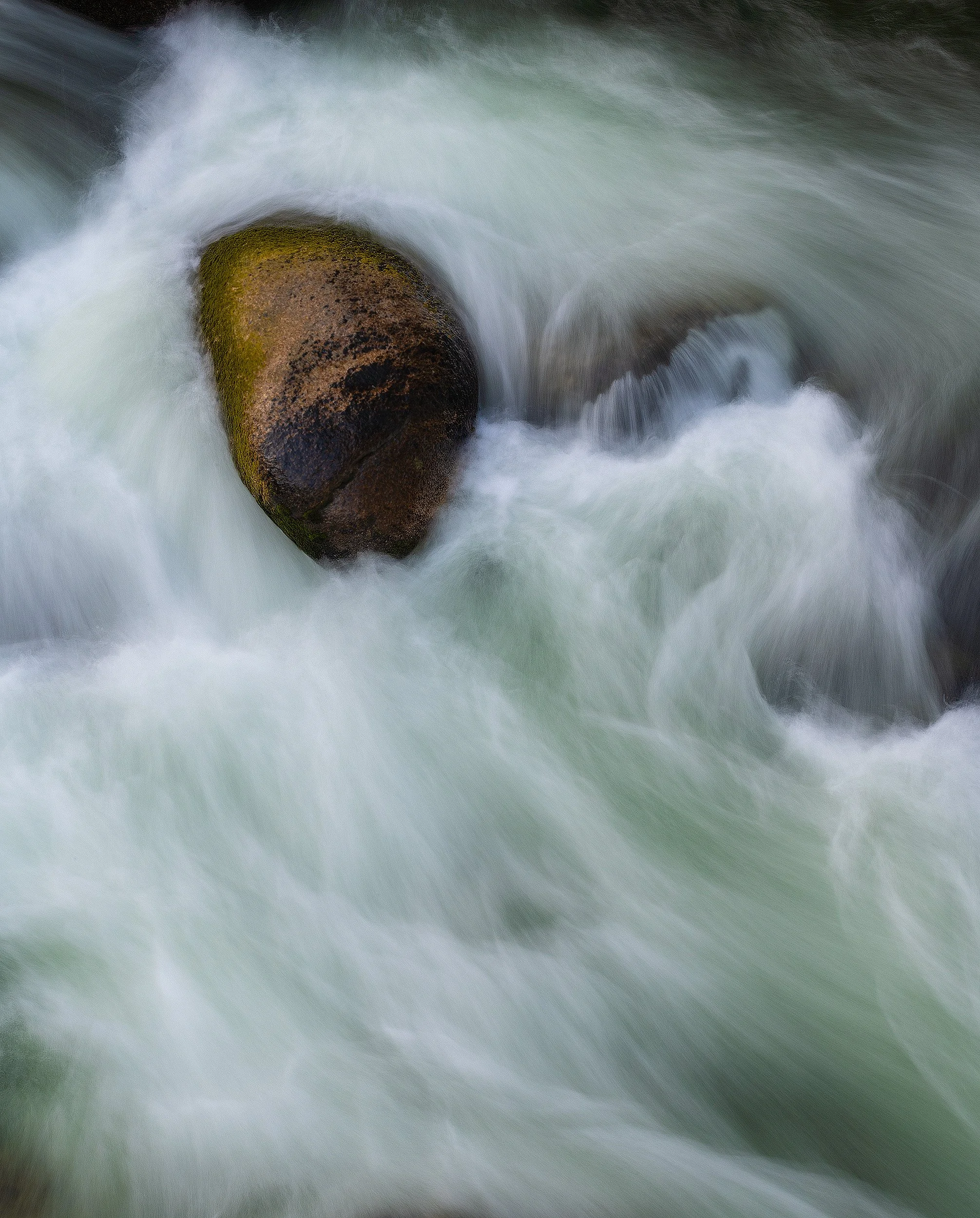
EXAMPLE: I can watch water for hours, and snowmelt time in California is almost a season unto itself. Talk about water music!
Photos of streams and waterfalls are studies in shutter speeds. Do you want crystal-sharp, frozen spray? Or an ethereal flow? At super-slow speeds it all turns into a primal froth, which is cool, but…I usually want more shape and texture.
My image ‘Spring runoff,’ shown at left, is all about the flux and flow of fast-moving mountain water that’s wrapping around that lone, fixed boulder. Aperture wasn’t a big issue here, but shutter speed was key. So, with my Nikon dslr mounted on a sturdy tripod, I tried several settings, and the one I picked was 0.6 seconds, which I felt was the sweet spot between softness/flow and a certain amount of shape and muscle. Your mileage may vary, so it’s best to explore your options. And the faster the flow or the longer the lens, the greater the blur.
When I printed this image for a recent gallery show, I went through lots and lots of test proofs, plus several full-size versions, too, trying to get that water looking just the way I wanted. It wasn’t just about “motion” now, but about highlight separation, midtone color, and just a touch of weight, too. Plus, there were those skylit and shadowy portions of that boulder to add the pedal tone or bass. It’s that interplay of strength and grace—the immovable rock and the seemingly endless flow and dance of the water around it—that I found fascinating.
By Scott Atkinson
Contents copyright 2026. All rights reserved.