Reflections
What if I could have fresh eyes and view the world anew? Or take a step back and re-calibrate what I’m photographing? Swim with wavering shapes and colors. Dive into submerged worlds below this world. Bob amidst objects and meanings. And float downstream to a new story…?
Today I’ll focus not on things, but on their reflections, expressions of a watery world. It’s a dose of tunnel vision within the grand landscape. A joyful, stubborn shift in “subject matter,” ignoring the solid. I’m heading down the rabbit hole, really.
So, here’s the assignment: Just watch water. Watch light on water. Watch wind-whipped diamonds sparkling on water. Watch clouds drift across the surface. Surf with the tree shapes atop tiny waves in the afternoon breeze. Settle into the mirrored calm at dusk, like the insects touching down on the still surface, and then the gentle, spreading ring from a trout rising to feed on them. Maybe even shoot by moonlight only—a double reflection.
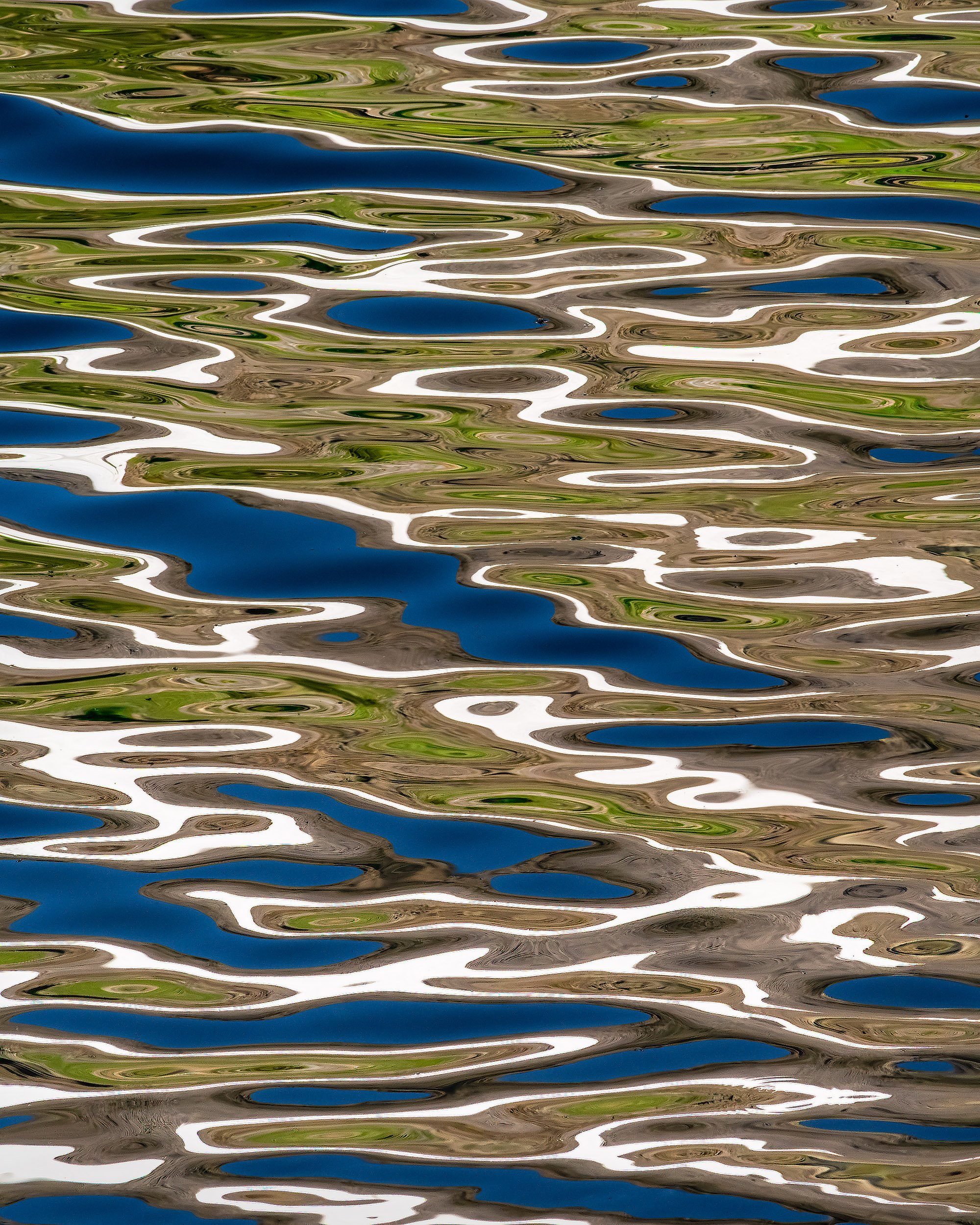
I could do this almost anywhere, but I began it several years ago while camping at 8,500 feet near a certain Sierra lake…and I now try to return here each summer. It’s an annual leap of faith. Monogamy in the mountains. A twist, yes, but strangely grounding. Other campers and kids and fishermen are puzzled by what I’m aiming my camera at, but I’m largely left alone…circumambulating the lake…for days at a time.
Waking within the bubble of dawn’s hush, I first brew some tea and chat with the first hopping juncos…then it’s off to work. By daylight and moonlight and starlight, through wind and calm, I’ll track my course by water. What will I see?
For these journeys, I usually reach first for my 100-400, which I call my “water lens.” But I also brought my longer 400-800 this time. And sometimes I’ll shoot with something shorter. Maybe the shutter speed is fast and frozen, but often I let it drag and blur. It’s all good. The camera is fixed atop a sturdy tripod and I don’t move that—but, of course, that’s an option, too. Here, I’m just letting water paint itself.
Maybe I’ll start by watching highlights only. Then invert that and study just the shadows. And what’s that color in the quarter tones? And in the three-quarter tones? All unique worlds, all swirling, always changing. What makes the picture?
Some would say: “But there’s no sense of scale, there’s no context…” Great, that’s what I want. “Where is the ground? The lake, the mountains, and clouds? The real world?” Rocks, trees, snow, and sky are all around, yes, but LOOK: They’re there on the water, too. “It’s too abstract.” Really? How, when you think of it, can it be abstract? It’s a photograph. The camera reshapes one’s eye—defying gravity, the Newtonian narrative that rims the lake. I’m hearing Gillian Welch’s ‘Empty Trainload of Sky:’ “Is it spirit? Is it solid?”
But what’s not real here? Lines, shapes, colors, and textures are all set free...if we let them be. I just need to step back and live again. The world is a wonder.
OK, I guess these are my reflections on reflections. Light and life ripple outwards, like the ring from that rising trout, or the morning trill of those dark-eyed juncos. Or, say, the “double mirror waver” in Gary Snyder’s ‘Bubbs Creek Haircut.’ Countless views. My camera slows and shows one moment, one frame, from one shore. These images, and later the prints, are like pine needles bobbing on the lake’s surface, softened and silenced by time.
But all around that the water keeps flowing, coming and going. We flow onwards, too. And today, I’m fine with that.
Sometimes surfaces are enough.
By Scott Atkinson
Contents copyright 2026. All rights reserved.