Oaks on a Thousand Hills
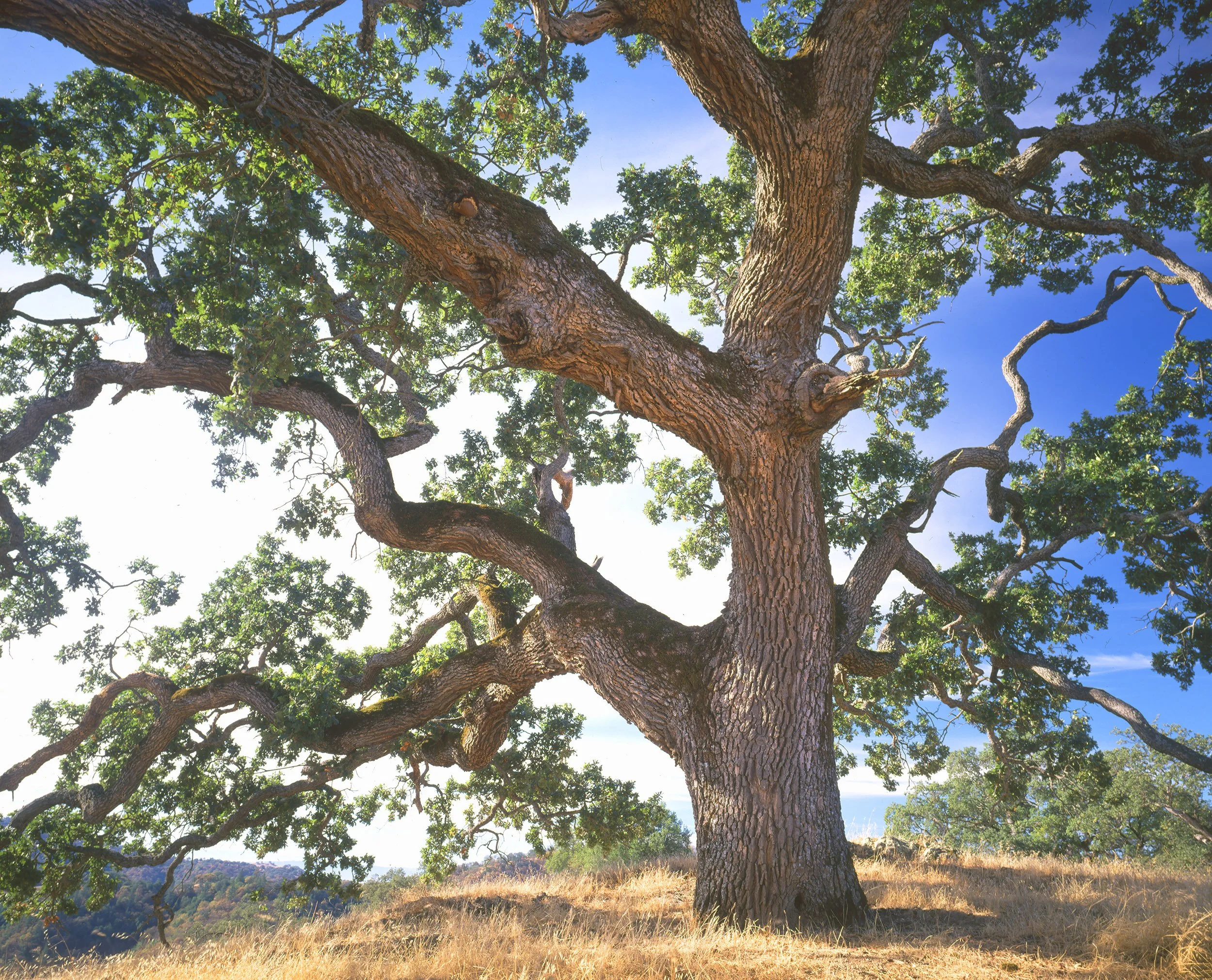
Picture a scroll painting that’s traveling eastward past California’s coast, valleys, and foothills, and unfurling down the years, too. On any such journey, through both time and space, oaks would be iconic.
You’d wind through coastal canyons; oak woodlands; riparian forests; and foothill savannas. Float by coastal live oaks. Valley oaks. Blue oaks. Interior live oaks. Black oaks in the foothills and up the western slope’s river canyons. Oaks everywhere, infinite dots on a thousand hills. The promise of plenty, of open space.
Pause at any tree you like along the way. Listen for the songs of the oak titmouse and acorn woodpecker…or the satori-squawking of a scrub jay…a bustling of bluebirds in the overstory…and the rustling of ground squirrels and alligator lizards in the grasses below. Watch and feel the evening breeze move the leaves and branches.
A large part of the food an oak produces feeds those around it. It begins, of course, with acorns, once a primary daily food for most Native Californians…and for eons of acorn woodpeckers, jays, squirrels, woodrats, and deer.
But other meals are on the menu, too: oak leaves, bark, branches, and roots. Life for insects, birds, reptiles, amphibians, and mammals. Plus shelter for these and more in trunks, branches, galls, mistletoe, or rotted downed logs.
Then there’s the even larger world below the ground. A network of roots…and mycorrhizal fungi…things that talk to each other in the dark. Beings that only live in, on, or among oaks.
Many worlds, many viewpoints—what Jakob von Uexkull called “Umwelts.” But there are really no lone individuals…they’re all intertwined. They call it a “guild.”
I think of John Muir’s classic quote from ‘My First Summer in the Sierra’: “When we try to pick out anything by itself, we find it hitched to everything else in the universe.”
Oaks are time travelers, too. From Native Californians to Tech Bros—it’s hard to think of two more different worlds. Yet this transformation has taken place in less than the lifetime of some valley oaks.
These days, we seem to ignore any timeline that goes back beyond our own origin myth, The Gold Rush. Or, maybe we add on the mission era, as we all learned in 4th grade. In 1542, Cabrillo made landfall in Monterey. In 1602, Vizcaino was first to explore. In 1769, Portola traversed from San Diego to San Francisco Bay. That same year saw the first mission under Father Junipero Serra.
But maybe this valley oak I’m running my hand across was already here before all that. What’s its history? What are its memories? I’m listening for whispers and words of wisdom, but I don’t know the language.
When an acorn drops, that seed must live where it comes to rest. Can we imagine ourselves putting down roots…and staying there? (OK, maybe if we have wi-fi.) Manifest Destiny is back in style. The oak stays centered, while our lives rush around it like a noisy jabber of jays. We’re on a collision course. Here come the bulldozers. But as Edward Abbey liked to say: “Growth for the sake of growth is the ideology of the cancer cell.”
Who owns this? Who is owed this? Sign on the line and the oak and all its constellations of life are…yours? What happens to the rest—including us—if they’re gone?
Were we really meant to live in an ant farm?
Von Uexkull’s bat hangs upside down and “sees” by sonar. So what’s my umwelt? Maybe reflected light, as seen through a viewfinder. Light means life not just for the forest, but for photographers, too.
And certain landscapes call one homeward. You fall into them and never quite come back. Oaks are like that. They tell stories, and that’s what I’m always looking for with the camera. Maybe photos show umwelts, too, no matter the scale. The world spreads outwards from the focus of a lens—like a scroll painting in 3D. California’s ancient voice is humming softly, but what is it saying? And then I get it: its words and thoughts are simply these many things themselves. We haven’t wrecked all of it yet. Is there still a conversation that leads to conservation?
Imagine a natural world that we’re also a part of. Oaks could still root us all in California. But we’re not the stewards here; they are. Can we join the guild, too?
There are so many pieces of ourselves outside of ourselves.
By Scott Atkinson
Contents copyright 2026. All rights reserved.