Frame Your World
I’ve edited others’ work for many years—first in the film days with my eye pressed to a Schneider loupe on the light table, and then in more recent times with a large, color-calibrated desktop monitor and a print-proofing lightbox. What’s one of the most common pitfalls I see with outdoor pictures? Easy: It’s using a camera like a gunsight.
The camera’s view is a rectangle, and everything in that space is your business. The shutter’s click freezes whatever is inside those lines, and though you may see just one “subject,” it’s surrounded by a supporting cast, and those other players need to balance, too. The tiniest changes in cropping, angle, scale, sweep, and compression can make a huge difference. Learn to look closely at your options.
Lenses spread or shrink space and can push or pull lines and objects. Do you want a wide-angle sweep or a telephoto stasis? It's all about energy and movement…or not. A wide lens not only takes in a broader view, it stretches space between and behind your foreground elements—including, maybe, that distracting blast of white sky through the trees. A longer lens will pull things together, and maybe also soften or blend them. Which do you want?
Camera bells and whistles can get in the way of simply seeing. Try putting the camera down and looking through a framing card, which is just, say, an 8x10 piece of stout cardboard with a cutout that’s the same shape as your preferred image ratio. (I've always used one of my early 4x5 film mounts.) Want to check out what a wide-angle view looks like? Bring the card towards your eye. Going telephoto? Hold it at arm’s length. Move the card around and also step left, step right and back and forth; kneel or stand tall to find relationships or tame clashing elements. And watch those edges!
It’s not really a thought process—it’s a dance, a matter of feel. Think of your eye as walking through the picture. If you’re not excited when viewing it now, you probably won’t like it later, either. Keep playing and have fun.
When composing like this, you’re both seeing and you’re making. (Sound familiar? See “Simple Things.”) And whatever calls to you, just remember that there’s no single subject: It's ALL your subject. In any given spot, you may well choose something completely different than I would. I hope so—you’re framing your own world!
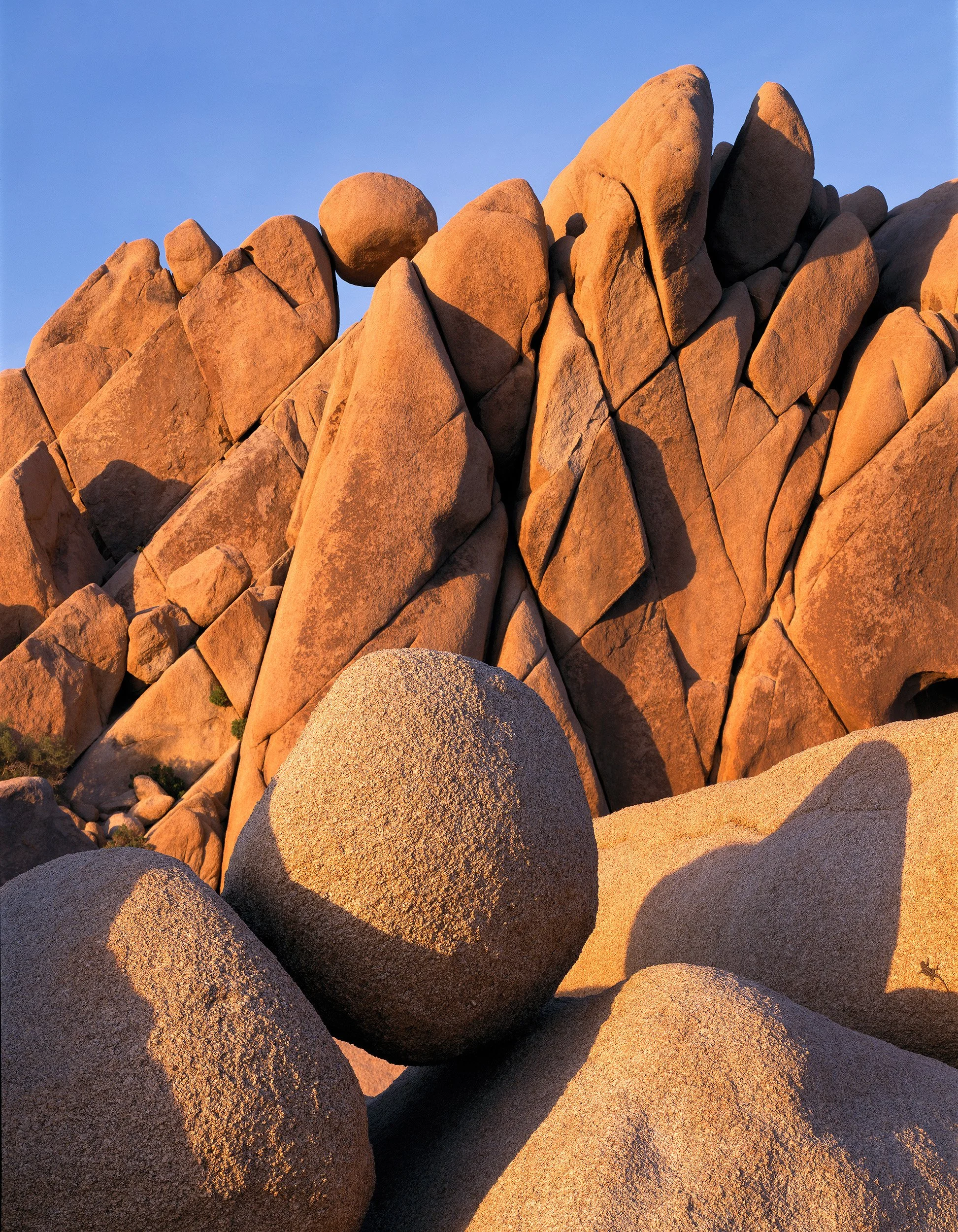
EXAMPLE: In my image “Boulders & bonus lizard,” shown above right, I was playing with the geometry of all those elements. FWIW, note how the foreground and background boulders line up. How the high point of the ridge leans in rhythm with what’s below. How the foreground boulder falls nearly exactly within the triangle behind it. And how that boulder’s shadow pulls right but stays inside the sunlit rock surrounding it and within the frame. To fine-tune all those things, I needed to get my 4x5 view camera and tripod into the exact right spot, which meant jamming them down into a crack between rocks, then wedging myself down there, too—or at least enough of me to see the ground glass sorta sideways; and then I had to crunch down again and make lens adjustments and insert each film holder as the evening light got warmer and softened. My beloved 240mm Fujinon lens gave me the slight compression I wanted.
See the little lizard? He or she showed up for the last few exposures and watched me with head cocked, then politely sat still as I worked. We chatted. If she had moved even an inch, I would have needed to adjust for that, too!
By Scott Atkinson
Contents copyright 2025. All rights reserved.